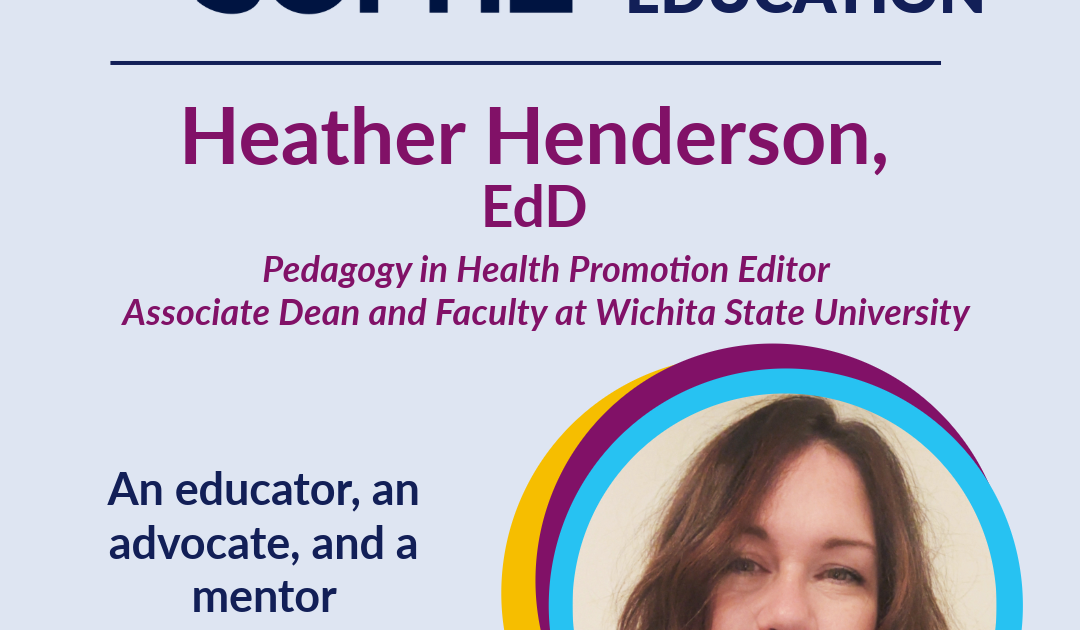

When asked what she wished more people understood about public health and health promotion, Dr. Heather Henderson said this: “Compassion and taking care of your community does not take away from you.”
The latest member in our Faces of Health Education has held true to this sentiment throughout her career: as an educator, an advocate, and a mentor.
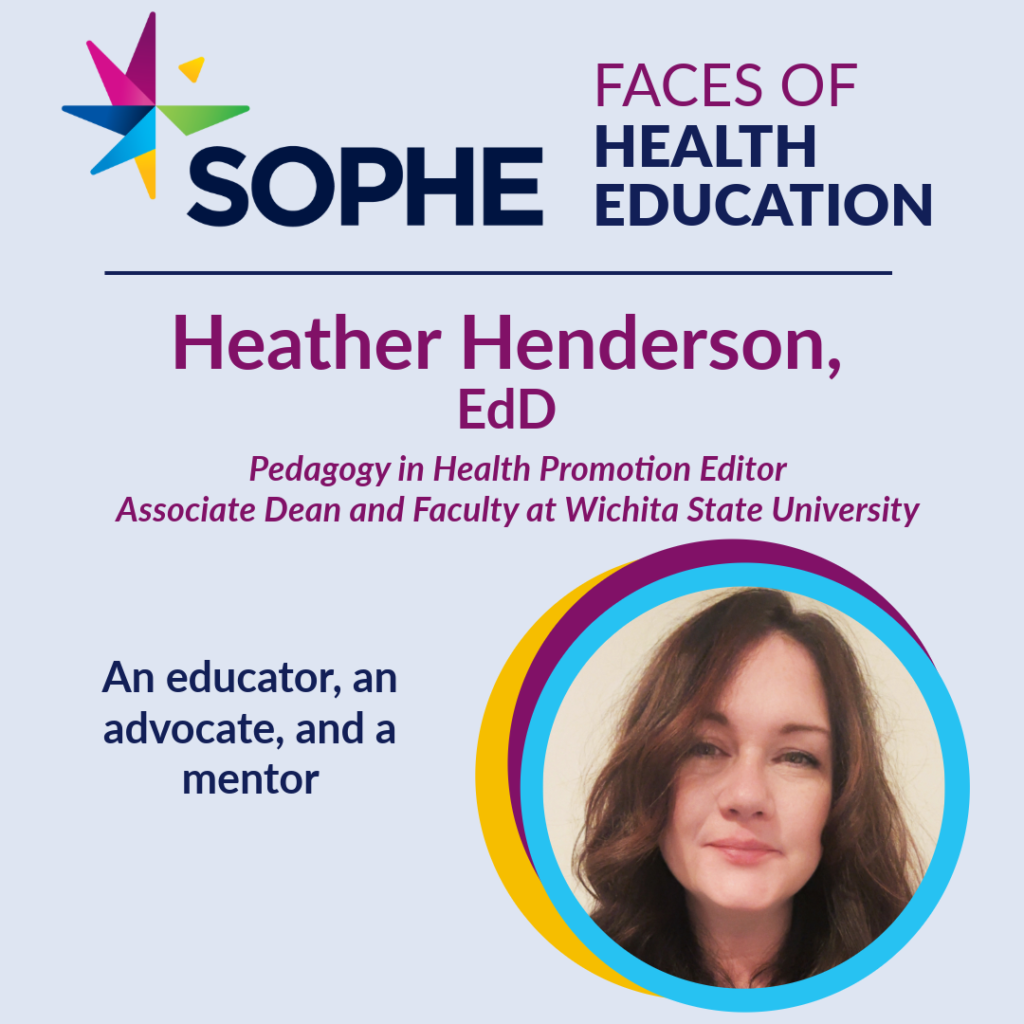
Henderson is currently the Editor of SOPHE’s Pedagogy in Health Promotion and an Associate Dean and Faculty at Wichita State University. Originally trained as a social psychologist, Dr. Henderson fell in love with public health after what she calls a “happy accident”: taking a job in public health that she thought would be temporary. She realized that she could play a part in not just improving her local communities but lay the groundwork for future generations to thrive.
Her path to public health was influenced by her childhood in Appalachia, where she saw the struggles of rural health and socioeconomic challenges. As she started her career as a K-12 educator, she saw the same struggles in urban areas. As an educator, working with children who were lacking necessities, in an environment that without the health and support services they needed, and seeing an alarmingly high mortality rate in high school students- an experience she described as eye opening. To her, public health was the first time she had seen that impact of multiple interacting problems considered together. She saw a path forward that could make a difference beyond the individual level, and as her career progressed, she sought out more opportunities to help professionals cultivate their own skills.
This passion is what brought her to Pedagogy in Health Promotion at SOPHE. Henderson considers health promotion to be “undervalued and underrepresented in society,” and looked to do her part in changing that. She says she is passionate about cultivating trust in interventional work and helping professionals develop not just the technical skills, but the psychosocial resilience needed to stay in the field.
Hand in hand with that is her passion for organizational culture as well: looking to support professionals who feel out of place in their programs, hoping to bring them solutions that help them not just get by, but thrive in their positions.
She brings this community-based approach to her editorial style as well, through one-on-one mentoring, workshops, and informal feedback opportunities before official reviews. Henderson sees the potential to build up the “reputation and the professional identity of health education and promotion as a field.” She sees this as especially important, now more than ever, given the political climate surrounding public health right now.
One of her biggest passions is health equity, and it has increased tenfold after scrutiny by the current administration. Despite the shaky environment, she says she is “not willing to stop fighting” for this work. She argues that political messaging around equity is generating confusion, suggesting the idea that supporting one group takes away from another.
She says her work has always been dedicated to “reducing harmful environments for people considered outside mainstream norms.” Firsthand, she has experienced courses and research projects, that were federally funded, being shut down. As an editor, she has experienced authors asking to pull their pieces for fear of backlash or coming under fire. Being in an environment where colleagues are suffering from burnout, and debating if their work is worth losing their job has been draining, but she has been resolute in her commitment to public health work.
While these experiences are disheartening, it has fueled Henderson’s desire to continue pushing for the journal to be a safe space for diverse voices. And her community responded: she has experienced an influx of authors reaching out to share their gratitude the journal’s commitment to equity in thought. At its core, she believes that public health work is equity work: “reducing health disparities, serving people without a voice or resources.” Even if this label disappears, the underlying work needs to and will continue, she says.
This determination is what shapes the future of Pedagogy in Health Promotion for Henderson. She is excited when she looks around at the community of people who are still choosing to enter or stay in this work, despite everything going on, and people newly interested in learning more about it. More voices and building community are two of her goals for the journal, and she hopes to invite more educational and social psychology authors to contribute, to feature more work on neurodiversity accommodation techniques that support all students and to launch more case studies in the journal.
It is important to her that more voices are featured because it can “broaden the scope of what the field can address, introduce new techniques and strategies from other disciplines, enrich the overall conversation, and counteract the tendency to only look at public health specific research, when other fields are tackling similar problems.”
Henderson is determined to bring more players into the system to tackle the challenges in public health. She wrote a piece called “This Beautiful Mess Where We Come Together,” where she talked about the field of public health and how its strength is how multidisciplinary it is, and what strides can be made to take advantage of that.
Reflecting on that piece now, she says while things are getting messier, the strengths are still the same. Now more than ever, she encourages rejecting “working in silos” and to “integrate across disciplines.” It is only when we look up that we recognize how many others are striving to solve the same problems, and how much farther public health can go when we choose to move forward together.