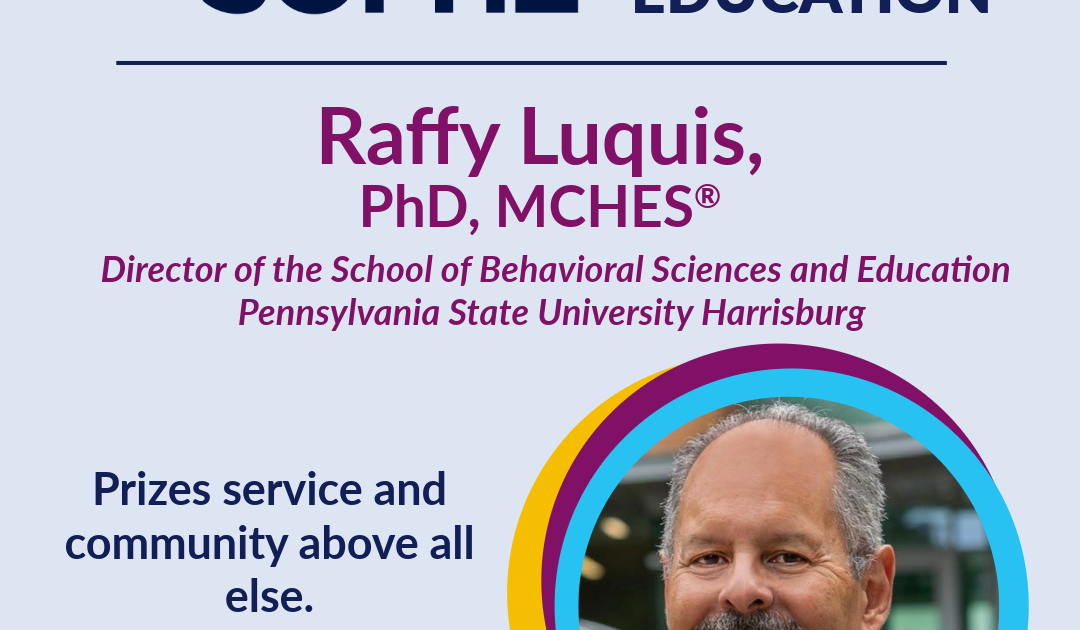

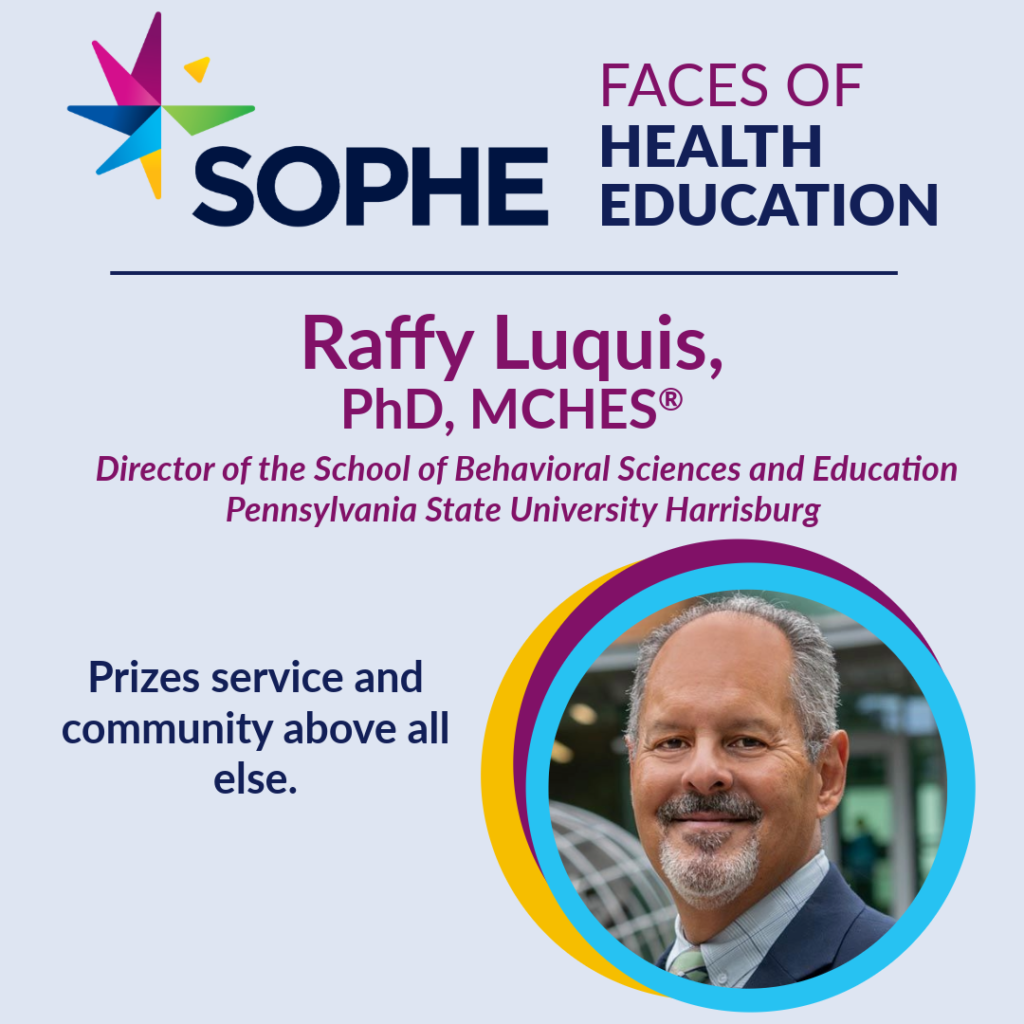
Raffy Luquis is a professional of many titles. He is currently the Director of the School of Behavioral Sciences and Education at Penn State Harrisburg, but he is also a public health educator, professor, former president of SOPHE, and a recipient of SOPHE’s Distinguished Fellow Award.
But most importantly, his career is one that prizes service and community above all else.
From working in the non-profit sector to academia, Dr. Luquis found a passion for not only furthering the field of public health but helping the next generation find their own calling. As a grad student TA, he fell in love with academia, guiding a mix of health educators and students in their path towards public health education.
What he found truly inspirational was being able to take part in so many people’s journeys. Dr. Luquis describes himself as someone with “a love for people that were still searching for their path and helping guide them towards what they wanted to do, because he sees himself in that experience.”
While Dr. Luquis’s career started in the non-profit sector, returning to academia gave him the opportunity to balance research and teaching in an entirely different way. In the 2000s, he realized that demographic changes in the US had fostered a lot of health inequities, a terminology that was largely undefined at the time.
The concept of cultural sensitivity was established in our vocabulary, but Dr. Luquis was a purveyor of cultural competency. Him and his colleague sought to write a book on it, and they looked to the experts in the field to contribute. His greatest pride is that professors are using this book to teach their students about cultural competency, but as the field of public health continues to change, so does he.
“As we continue to develop the profession, we also must continue to evolve,” he said.
He has pursued this love of learning through teaching and research, but also through giving back to his community.
One key way he does so is through his involvement with SOPHE. His desire to give back through being an active member and professional is what drew him to getting involved, first as a member, then as a Trustees of Communication on the Board, and then as SOPHE President.
While he explains that this was an entirely new endeavor for him, he jumped in headfirst because he was excited by the role he could play in furthering the public health profession. He encourages other professionals to take these risks and be active in these spaces because he believes that it is key to not just evolving your own career, but a valuable way to provide for the next generation of public health professionals.
He reflected on his first time as a student at a public health conference, and the excitement and awe of being surrounded by professionals that penned the texts he studied in class. Now, he is grateful to be the person younger students and professionals’ approach, and he is excited to contribute to an environment that keeps those interactions alive.
But as the world around us shifts and changes, his commitment to fostering an environment that emphasizes adaptability and community is unwavering.
“There is no one path to successes,” he says.
This is what Dr. Luquis preaches to the students who come to him for guidance, especially now as an administrator at Penn State Harrisburg. But this is the attitude he has adopted towards his work as well, especially in the current persecution of DEI initiatives. As he stepped away from teaching, his relationship with his book and his work changed, but he continues to share his research in the professional setting and in various projects.
While there is an increase in caution, the work continues: “In public health, the profession is to continue serving the community, and even if the language changes, the work is not going to end.”
Talking to Dr. Luquis reminded me of the importance community plays in public health. Service is at the core of the profession, but together, our impact is that much stronger. This profession is resilient and innovative, something that has become more important in recent years.
While certain challenges demand increasingly creative solutions, it is important that we do not lose site of the resources we do have access to; a community of talented, inspiring professionals with the same goal.
________________________________________
This blog post was written by Laya Raju, a student at Boston University who is passionate about information accessibility, community advocacy, and health equity within the field of public health.