
“Speak truth to power and speak truth to inequities in a way that is kind and moves the world forward.”
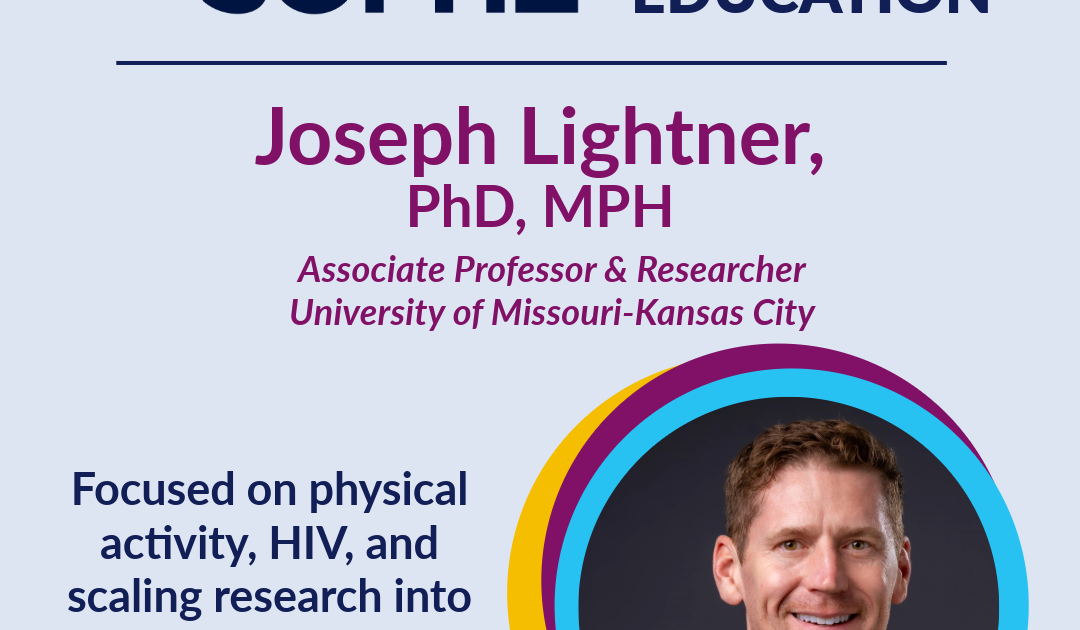
As an associate professor and researcher at the University of Missouri-Kansas City and interim editor of SOPHE’s Health Education & Behavior journal, this perspective guides Dr. Joseph Lightner’s work across his roles in public health.
This month, I got the chance to talk to Dr. Lightner about his journey to public health, and how his identity, passions, and evolving interests came together to form such a robust career.
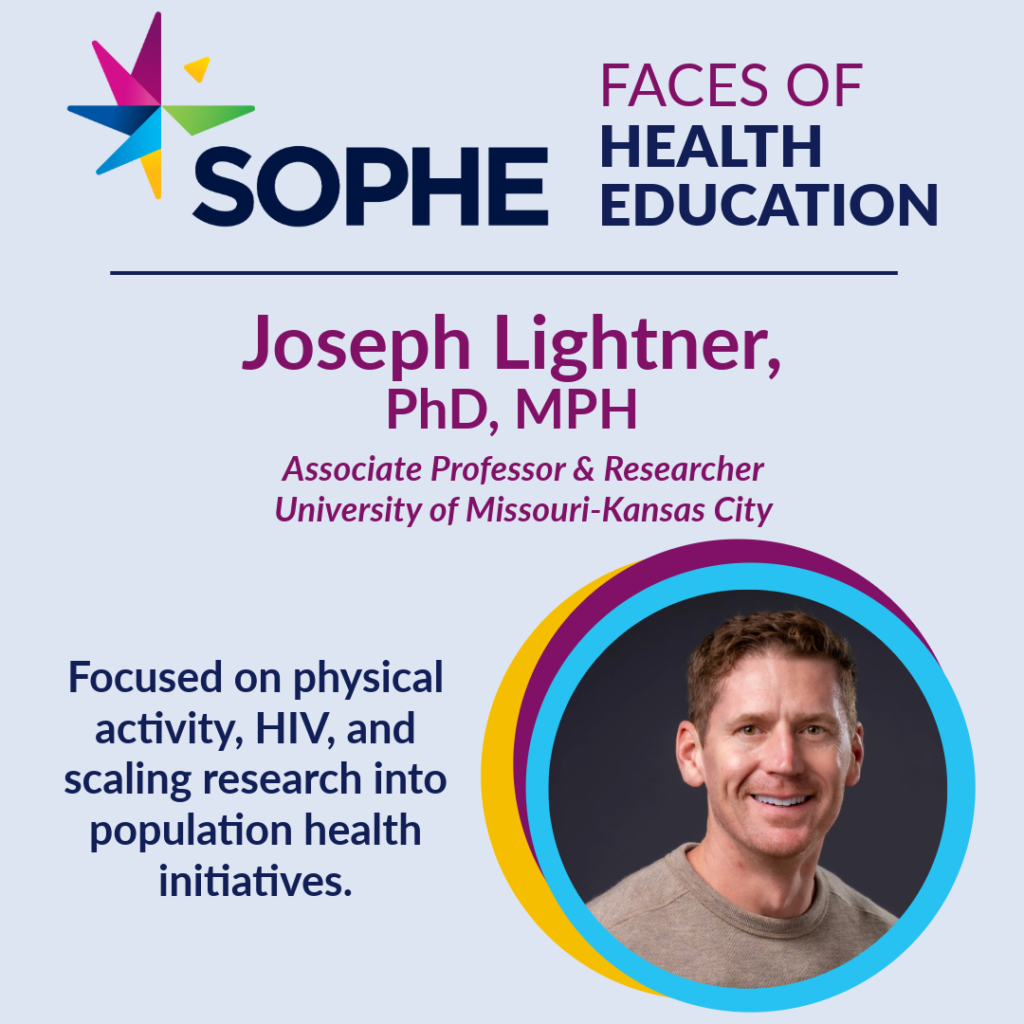
His path into public health started by being an undergrad biology major, when working in a public health research lab introduced him to a new set of possibilities. In grad school, he pursued that interest and shifted away from focusing on individual health and toward population level systems. He continues that work today, teaching research methods at UMKC while delving deeper into his own interests.
Research is the cornerstone of Dr. Lightner’s work, his focus areas being physical activity, HIV, and scaling research into population health initiatives. One of Dr. Lightner’s most significant projects is a literature review on the stigma transgender individuals face and how it impacts their access to physical activity. His team used this piece helped write and move policy through the governing council of APHA (American Public Health Association), something Dr. Lightner noted with pride and gratitude.
“That’s the kind of leadership we need, where we can stand up for science and marginalized groups,” he said.
That commitment has become increasingly important in a political climate where research, equity, and identity are increasingly contested. Dr. Lightner sees that work as essential rather than optional. He speaks about identity and diversity as strengths that make the field more empathetic, responsive, and meaningful.
Reflecting on his own life, Dr. Lightner shared how his experiences as a gay man shaped how he thinks about health, belonging, and access, especially in physical activity spaces where he often felt outside the norm. He believes that these experiences have deepened the empathy he brings to his research. Rather than separating personal identity from professional purpose, he sees lived experience as a source of insight that can strengthen public health work.
Dr. Lightner brings this perspective to HEB, where they recently drafted a commentary on Conservative Control and the Future of Public Health. They talked about how to navigate our current political climate, as well as restated HEB’s commitment to “considerate, evidence based, rigorous research that highlights inequities and marginalized communities.”
He also recognizes the privilege that comes with being able to speak openly as a tenured professor, and he is mindful that not everyone has that same security. For those who do, he offered this encouragement: “For those who are in a low-risk position, you may not have funded research, but you can still highlight the issues, do the science, and help out where you can, even in a world that is hostile to diversity.”
His ethos and approach to his work reinforces this message, as Dr. Lightner is someone who believes in emphasizing kindness, curiosity, humility, and being “process focused and outcome driven.” He believes that at the heart of doing good work is extending kindness to those on the same mission as us and to others beyond it.
Looking ahead, he hopes to build on the meaningful work his team at HEB has cultivated by supporting authors, giving substantive feedback, and genuine relationships. Ultimately, HEB hopes to disseminate author’s work as effectively and efficiently as possible through encouraging authors to reach out, ask questions, and start conversations.
My conversation with Dr. Lightner left me feeling excited and inspired. It can feel isolating when important work is overshadowed by larger challenges, but his perspective offered an important reminder.
A career in public health is not work we do alone.
It is built through a shared commitment, diversity of thought, curiosity, and care. Not only that, individual efforts and commitments to making an impact can grow into something much larger, shaping systems, expanding access, and improving lives. As Dr. Lightner reminds us, when we lead with kindness and stay committed to doing good work, good outcomes will follow.
________________________________________
This blog post was written by Laya Raju, a student at Boston University who is passionate about information accessibility, community advocacy, and health equity within the field of public health.