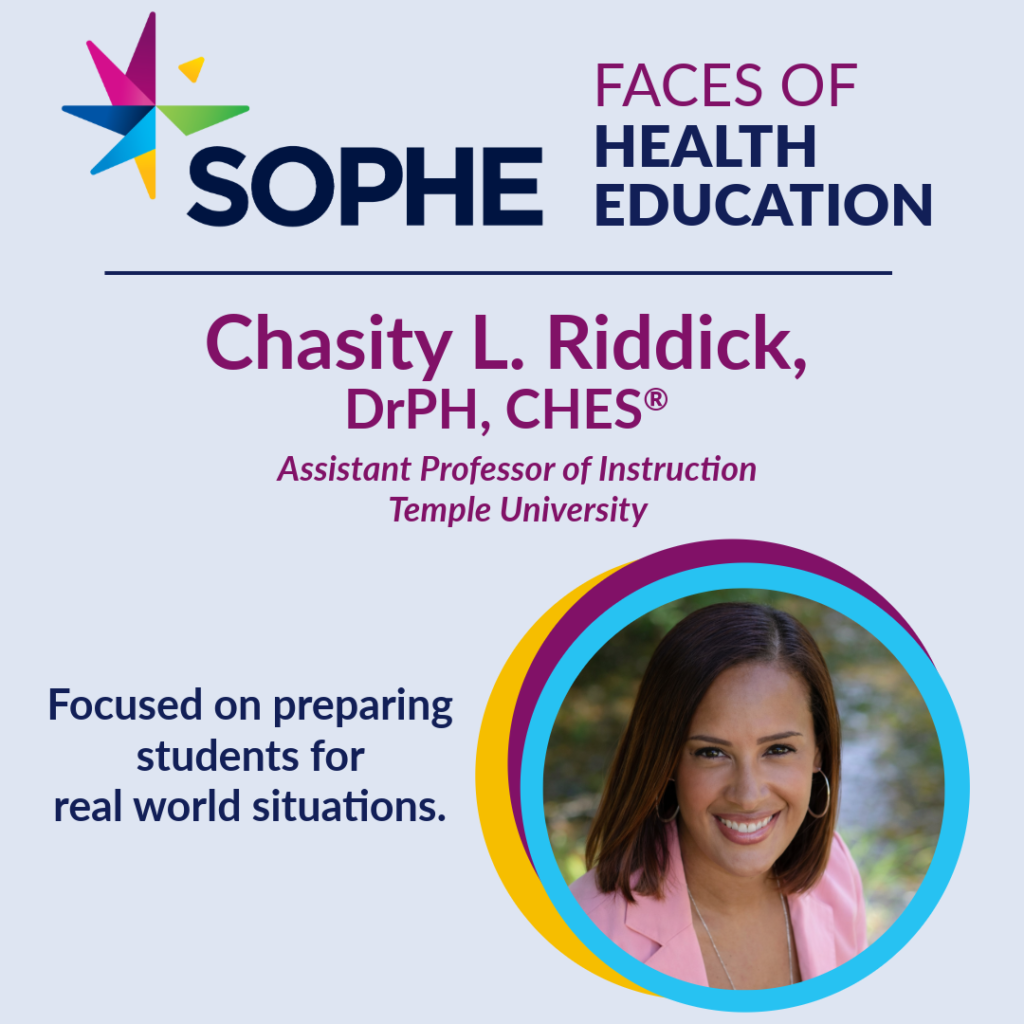
To Dr. Chasity Riddick, health is more than the individual. From where a person lives, works, and plays, health is the entire ecosystem in which they live.
Originally, she focused on exercise physiology and sport management. Because of her interest in helping communities live healthier lives, she pursued a DrPH. Currently a professor at Temple University, she has created opportunities for public health learning both inside and outside of the classroom.
Her doctoral research focuses on attitudes and behaviors toward physical activity among African American female college students, bringing together her interests in physical activity, health education, health disparities, and the experiences of women of color.
Riddick’s teaching has always focused on preparing students for real world situations. This year, she started a community-engaged course called Health in Philadelphia that sends students into the field. Through course content and preparation, students create projects in partnership with community organizations in which they learn about various public health issues. These projects are an opportunity for students to create real solutions for their community. In her other courses, Professional Seminar and Internship, students work with Temple’s Career Center to participate in professional workshops, develop resumes and cover letters, and practice interviewing and professional communication with community partners and professionals. After the course, students partner with organizations and transition from student to professional.
She is also the faculty advisor for Temple University’s Alpha Omicron chapter of Eta Sigma Gamma, mentoring students in leadership, service, and professional development. Her greatest pride is in “watching students begin to see themselves not just as public health students, but as public health professionals.”
Being a member of SOPHE has allowed Riddick to create relationships with health education professionals across the country, learn from people working in different areas of public health, and contribute to learning outside of her university. She has taken on leadership roles in SOPHE’s Annual Conference Program Workgroup.
Due to her contributions to public health education, she is the most recent recipient of the 21st Century Health Education Practice Scholarship. Being awarded the scholarship allowed her to attend the 2026 SOPHE Annual Conference in Portland, in which she moderated sessions, connected with Eta Sigma Gamma members, and built new relationships inside and outside of formal sessions. She accessed “new relationships, learning, and experiences that continue to influence [her] teaching, service, and professional involvement.”
For professionals wanting to go into public health education, Riddick says to give yourself permission to grow and change. Every path is unique, and public health education is broad, but there are countless ways to make an impact. Joining professional organizations, volunteering for committees, receiving mentoring, and building relationships with people in the field and community are all critical to a successful career.
“Stay curious and stay connected to people,” she said. “We can teach theories, analyze data, conduct research, and develop programs, but public health ultimately happens in communities and affects real people. Listen to them, learn from them, and remember that sometimes the most important learning happens outside of the classroom.”
________________________________________
This blog post was written by Rea Yoh, a public health graduate student at Dartmouth College.