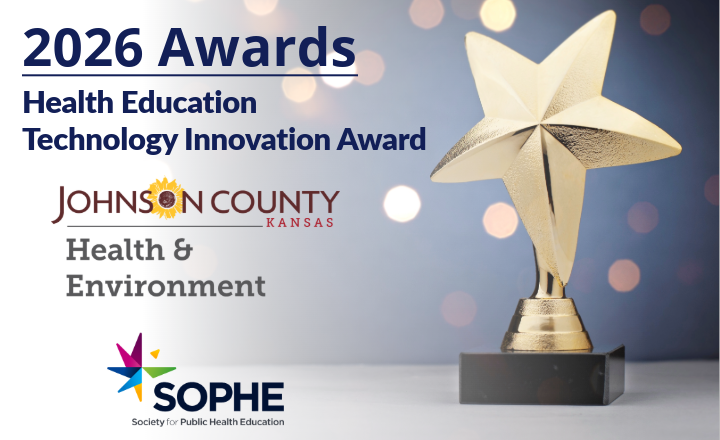
ALEXANDRIA, VA. – The Society of Public Health Education (SOPHE) is proud to announce Johnson County (KS) Department of Health and Environment will be awarded the Health Education Technology Innovation Award for its Health Lotería program during the 2026 SOPHE Annual Conference in Portland, April 22-24.
“I felt an incredible sense of validation, not just for the work I put into this project, but for the community voices that shaped it,” said Michael Gibson, disease investigator at the Johnson County Department of Health and Environment and creator of Health Lotería.
This award recognizes individuals or groups who have distinguished themselves by applying innovative, non-commercial technology in health education. This technology can be broadly disseminated with the potential to make a significant impact in health promotion and education.
“Working in the public health field, you see the massive trust gap and the communication barriers that Spanish-preferring families face every day,” Gibson said. “Receiving the Health Education Technology Innovation Award from SOPHE confirms that there is a significant, recognized value in creating tools that are both culturally resonant and technologically innovative. It was an exciting moment for our team and Johnson County community partners because it shows that public health is at its best when it prioritizes equity, innovation, and community involvement in equal measure.”
Health Lotería is a culturally-responsive, bilingual intervention designed to bridge the gap between public health services and the Hispanic/Latino community in Johnson County, Kansas. By adapting the traditional game of Lotería into a health-promotion tool, the project utilizes gamification to share vital community resources in a familiar, family-centered format. The program features a physical game set of 54 cards, each co-developed with community partners and equipped with a QR code that links to a live, digital resource index of local health and community services. This hybrid approach—validated by departmental clinical data and community feedback—has demonstrated a measurable 87% increase in institutional trust and a 96% intent-to-use rate among participants.
“I believe this project stood out because it uses widely accessible technology to help bridge a cultural divide and measurably increased institutional trust,” Gibson said. “So often, public health institutions struggle to find methods to build community trust. We were able to address this by taking a familiar cultural touchstone—the game of Lotería—and using it as a gateway to a bilingual digital resource index. By placing QR codes on physical game cards, we created a low-barrier way for residents to navigate essential county services all on one Lotería-themed webpage. This hybrid approach allowed us to meet the needs for Spanish-preferring households while providing a flexible digital platform that we can update as community resources evolve. It’s a practical, scalable solution to a long-standing barrier in health communication.”
SOPHE will present all awards and scholarships to public health professionals, health education researchers, faculty, programs, and practitioners at the 2026 SOPHE Annual Conference. These awards and scholarships recognize significant advancements in the profession of health education and health promotion and outstanding contributions of veterans and rising stars to improving the public’s health.
# # #
About SOPHE The Society for Public Health Education (SOPHE) is a nonprofit association that supports leaders in public health, health education, and promotion to advance healthy and equitable communities across the globe. SOPHE members work in health care settings, communities, organizations, schools, universities, worksites, and in local, state, and federal government agencies. For more information visit www.sophe.org.