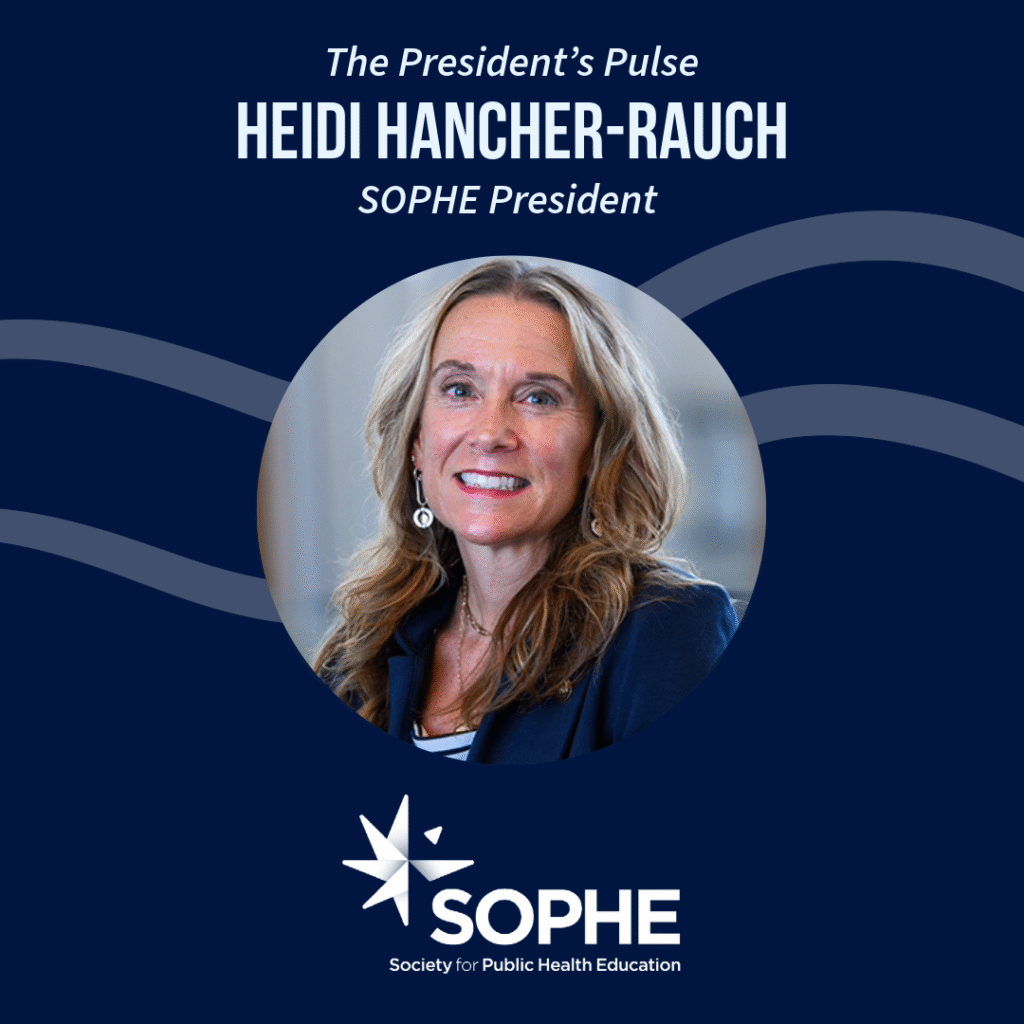
Update from SOPHE President Heidi Hancher-Rauch

While I have never been one for traditional New Year’s resolutions—which often fade before February—I find immense value in starting the year by setting clear personal and professional intentions. These intentions help me align my focus with what matters most at this stage of my life and career.
Like many, I often set intentions around wellness and reading. During graduate school and the early years of my academic career, pleasure reading was a rare luxury. Today, I intentionally carve out time for it, particularly within the genre of historical fiction. I find myself repeatedly drawn to stories of World War II—not only for my love of European history but for a deeper, more urgent reason: the drive to understand how atrocities occur and how “good people” can become complicit through silence.
As an advocate for justice, I often reflect on how I might have responded during such a pivotal era. While we can never truly know our own fortitude until it is tested, I find hope in the stories of the “helpers” and the “resisters.” I like to believe I would have been among them.
Finding Agency in Small Moments
I recently finished Kristin Harmel’s The Stolen Life of Collette Marceau (2025). In her author’s notes, Harmel offers a reflection that deeply resonates with the mission of public health:
“One doesn’t need to have a specific title or a specific education to become an agent of change. Change happens one act of courage at a time, one act of kindness at a time, one act of faith at a time. And those are things that all of us are capable of” (p. 365).
In an era where the news cycle can feel overwhelming, it is easy to be paralyzed by the enormity of the challenges facing our society. However, we cannot allow ourselves to be frozen. We must focus on the individual acts of which we are capable. For me, this manifests in the classroom. I begin each class by asking my students: “What is happening in the world right now that impacts the health of our communities?” My goal is to cultivate a habit of attention. I want them to recognize that every global and local event has a downstream effect on health and health equity. To engage in acts of courage, we must first understand why those acts are necessary.
Our Intentions for the Year Ahead
As Harmel concludes at the end of her notes, changing the world does not require immense wealth, power, or even “big, bold acts of courage.” Rather, it requires us to look inward and ask how we can stand up for what is just in the small moments of our lives. This reminds me that we all possess power, regardless of our titles. Our responsibility is to use that power in whatever capacity we have at the moment.
As I look toward 2026, my primary professional intention is to continue training the current and next generation of health professionals to:
- Pay attention to the world around them.
- Synthesize information from reliable, valid sources.
- Reflect deeply on that information.
- Act decisively within their spheres of influence to make the world a better place.
Change starts with the recognition of our own agency. I invite you to join me in this intention. What is one thing you have the power to do today to contribute to a healthier, more just world?