
Marajuana smoke. That is the first thing that Julia Alber smelled as she stepped into the apartment of an elderly woman, Joanne, in her community. A woman who does not in fact smoke.
“Overwhelming” is how Alber described it, and that was only after she passed through a cloud of the same stuff to enter the building.
Joanne, sitting in her smoky apartment, described the countless emails to her landlord detailing her respiratory problems, and the smoke that reaches her from the shared wall of her neighbor’s vents. The landlord’s response: I cannot tell residents what to do, but you can put in your 30-day notice if you wish to leave.
Why is Joanne subjected to this? The problem arises when many apartments allow residents to smoke within their unit, not a big issue since it’s their own house. But often, such as in Joanne’s case, this smoke can travel to the unit next door, forcing her to breath-in second hand smoke.
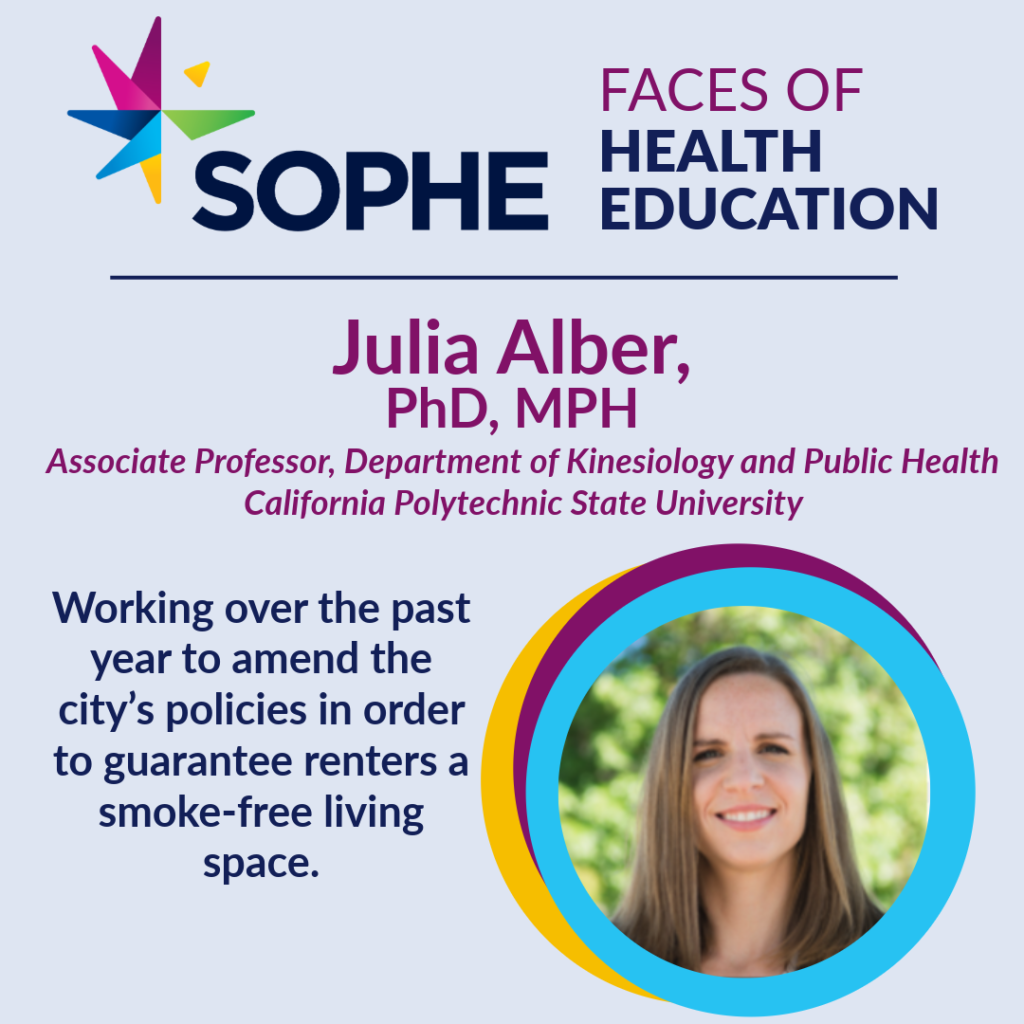
Alber, the chair of her county’s tobacco control coalition and a member of the SOPHE community for over 10 years, has been working over the past year to amend the city’s policies in order to guarantee renters a smoke-free living space. And this doesn’t mean she is anti-marijuana, just that “tenants have a right to live in a smoke free home”.
Meeting Joanne was a turning point for Alber, reminding her of the impact of her work on real people.
“This was a moment for me to see that wow, this is a person that is really being impacted by this issue,” said Alber, an associate professor in the Department of Kinesiology and Public Health at California Polytechnic State University. “That’s why moving forward with this arduous process of trying to get a city to change their [policy], this could be really helpful for them,” she says.
Alber knew that others needed to hear this woman’s experience as well, prompting her to invite the woman to speak in front of the next city council meeting.
“In advocacy policy, the stories are so impactful,” Alber said. “It allows others to resonate with people personally.”
And Joanne’s was no exception. The story resonated with the council, bringing to life the issue, offering a piece of her story, and in exchange the council felt the humanness of the issue. The ordinance was successfully added to the city’s goals. With the power of personal story, Alber and her team had succeeded.
Data and numbers matter. But stories have the power to move people. Policy is created by human beings for human beings but according to Alber, “people get overwhelmed when we just spit out [numbers] in public health.”
Allowing emotion into public health makes the work meaningful. And as Alber reminds us: stepping into the shoes of the people we are fighting for, even if just for a moment, is when this work comes alive.
*Joanne is a pseudonym
________________________________________
This blog post was written by Josie Miller, a student at Tufts University passionate about community health, storytelling, and honoring diverse lived experiences. This piece explores how real stories don’t just inform, they create connections, expand perspectives, and help build stronger, more compassionate communities.