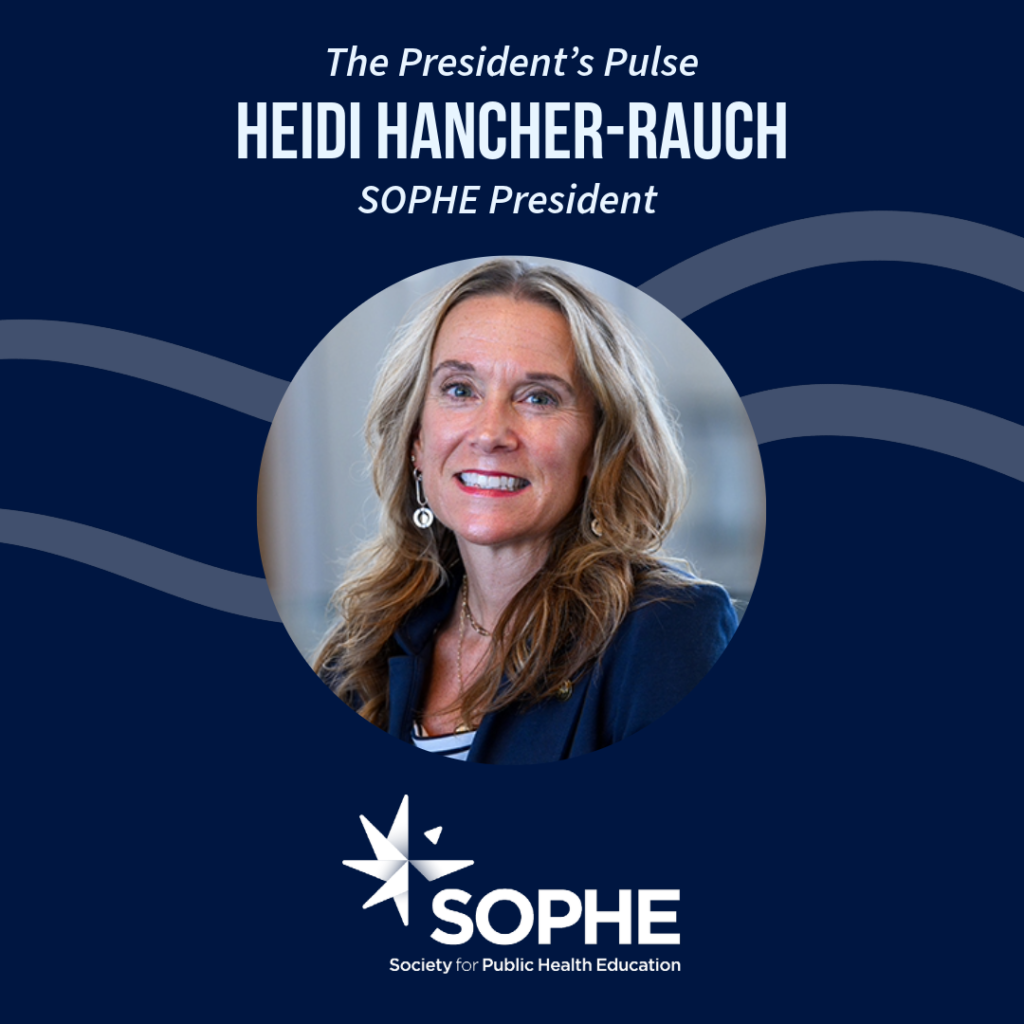
Update from SOPHE President Heidi Hancher-Rauch

It’s the time of year when many of us are heading into the season of festivities: gatherings with family, friends, colleagues, and communities. When preparing for these events, we often tell one another to avoid conversations that could create conflict—specifically, religion or politics.
It’s the time of year when many of us are heading into the season of festivities: gatherings with family, friends, colleagues, and communities. When preparing for these events, we often tell one another to avoid conversations that could create conflict—specifically, religion or politics.
This year, I’m asking that we think differently. I don’t believe we should enter our social events primed for controversy, but avoiding the really important conversations in “polite company” is arguably part of what has led us to this point—where we don’t feel equipped to talk with each other in an empathetic, open-minded way when we disagree.
The Public Health Opening
How in the world do I expect you to do this, you might be thinking, at a time of such political and cultural conflict? Let me be clear: I don’t expect you to ruin your evening or anyone else’s by starting arguments. Instead, let’s think about how conversations usually begin and how you might skillfully insert a bit of key information on a topic important to you—public health.
One of the first questions we often ask when we haven’t seen someone for a while is how their family is doing. Afterward, we often turn to professional roles: “How is your job going?” “Are you still working at XYZ?” This, my friends, is our opening.
Rather than focusing on the basics about job stress, schedule flexibility, or crazy coworkers, this is our chance to help people genuinely understand what we actually do in our public health roles.
Stepping Forward with Courage
I know, I know—we are not accustomed to talking about ourselves. Most of us are more comfortable in the background, letting our work speak for itself. But in this time of heavily curated feeds designed to elicit strong emotion, even the most introverted of us need to step forward with some courage.
This is our chance to talk about the passion we have for our communities, how the work we do is designed to help all people, and to provide examples of how public health systems and professionals are touching the lives of everyone in the room, even when they aren’t aware.
As Katelyn Jetelina, Your Local Epidemiologist, wisely said in a recent post, “A good defense demands offense.” She provided some great strategies about what a good offense might look like in this case: discussing our work in positive, strategy-driven, solution-oriented communication.
Conversation Starters to Try
I am always a fan of a conversation starting more naturally as you talk about your families or jobs, but here are a few conversation starters you may try to pivot the discussion:
- Public Health vs. Personal Health: “With everyone tracking their steps and sleep, personal wellness is a big focus these days. But even if you eat well and exercise, your health is also shaped by the environment you live in—like the nutrition labeling laws I work with, or efforts to make healthy food affordable for everyone. That’s the difference between personal health and public health. Have you ever thought about how much of your personal health is actually determined by the policies and structures around you, not just your own choices?”
- Public Health as an Economic Investment: “I hear your concerns about the economy and spending in this country. A lot of people think public health is expensive, but actually, it’s one of the best economic investments a community can make. When we prevent outbreaks like the flu or measles, or reduce chronic diseases through things like smoking cessation programs, we’re not just saving lives—we’re saving billions of dollars in emergency room visits, lost workdays, and long-term care costs. A healthy workforce is a productive one. When you think about our local economy, what’s one major health problem, like heart disease or diabetes, that you realize has a big financial impact on people you know?”
- The Global Connection: “We often think of public health as what happens right here in our city or state, but it’s really a global issue. Think about the last time you bought produce out of season, or saw a news report about a disease outbreak far away. Because of global travel and trade, a health problem in one country—whether it’s a new virus, resistance to antibiotics, or even a breakdown in clean water systems—can literally be on our doorstep in days. Global health is about working internationally to stop these threats before they become a pandemic, or ensuring that life-saving vaccines reach everyone. When you see news about international cooperation on health issues, does it make you realize how dependent our own family’s safety is on the health of people around the world?”
Our Role as Health Educators
In a nutshell, let’s put on our extroverted faces, overcome our discomfort, and really work hard to have the important conversations with our friends and families. Many of us have never been trained to effectively hold challenging, yet respectful, conversations with others related to things like politics and religion but we have the power to change this.
Who better to start modeling this ability than health educators? I look forward to hearing from those of you who follow through with this important task.